

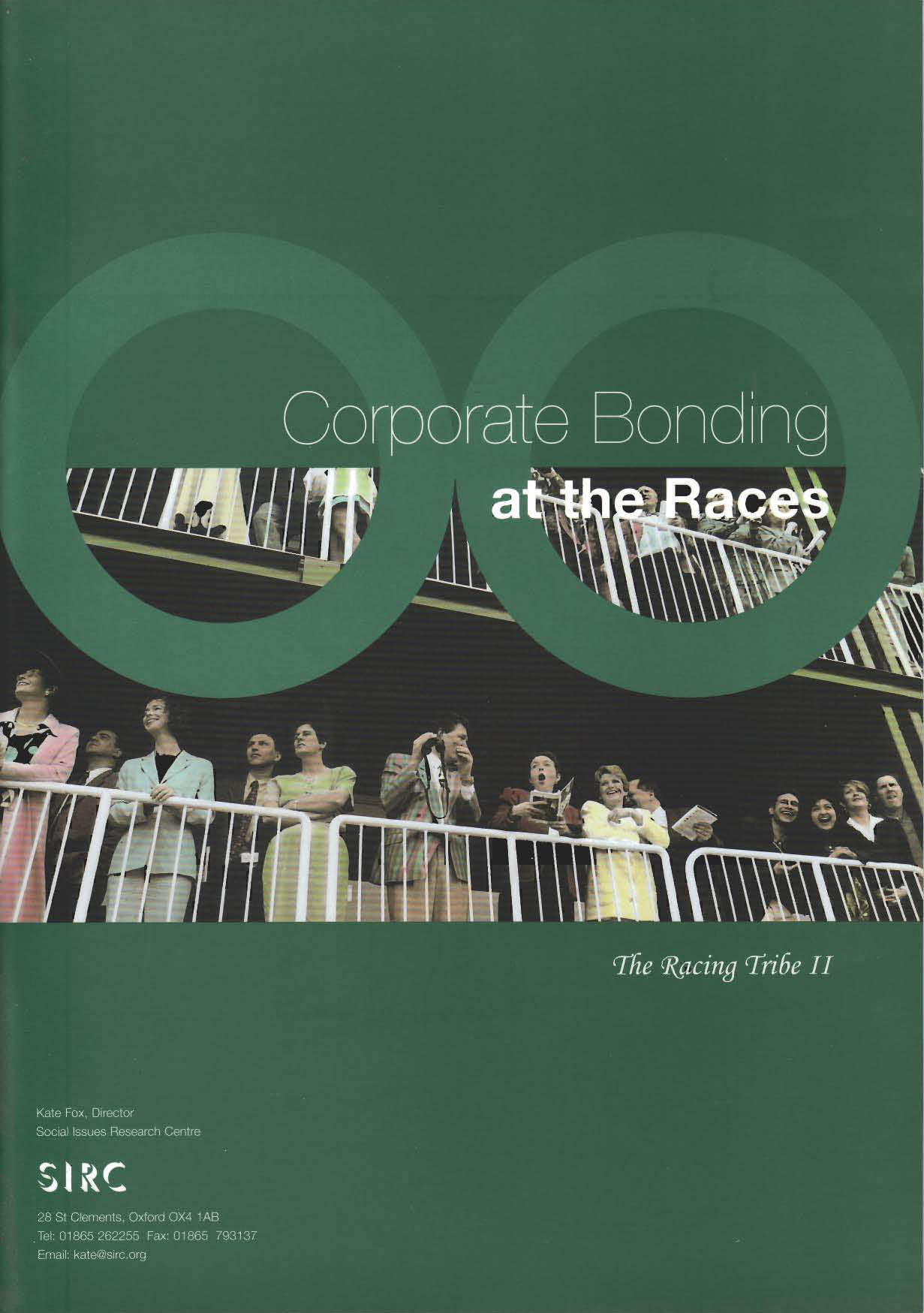




Corporate Bonding at the Races
Summary of an SIRC research report by Kate Fox
What is 'corporate bonding'?
'Corporate bonding' is a term used to describe the establishment, development and maintenance of good social relationships between business contacts or colleagues. (The term 'corporate bonding' was coined by the author of this report, anthropologist Kate Fox, as there was no existing shorthand term for this particular form of social bonding.)
Why was this research undertaken?
This project is a sequel to a more wide-ranging study entitled The Racing Tribe (TRT), conducted in 1996/97. The TRT research provided a broad overview of the culture, customs and social dynamics of the racecourse. The Corporate Bonding study focuses in more detail on one of the key categories of racegoer identified in TRT, namely the 'Suits' or 'corporate racegoers'.
- The principal aim of the Corporate Bonding study was to identify the means and mechanisms by which the culture and social dynamics of the racecourse facilitate social bonding in the corporate hospitality context.
- The study was funded by the British Horseracing Board and racecourse caterers Letheby & Christopher (with additional practical support from the Racecourse Association) and was designed to provide these organisations with a new insights into the psychology, behaviour and needs of their corporate customers.
- The findings will also be of interest to users of corporate hospitality at the races, particularly to hosts who want a more in-depth understanding of the role of racing in building business relationships.
- The study is also part of a wider Social Issues Research Centre programme of research focusing on positive aspects of human interaction and the causes of good behaviour.
What did the research involve?
The Corporate Bonding at the Races research was conducted by Kate Fox, Director of the Social Issues Research Centre, using the 'participant-observation' methods normally employed by anthropologists studying tribal societies. The original TRT study proved that these methods provide insights into the psychology and behaviour of racegoers which cannot be obtained through conventional market research.
- The study involved 11 months of observation work, participant-observation and interviews with hosts and guests at a representative sample of corporate events at different types of racecourses and race-meetings. The field research sample included a wide range of events, from major sponsors. hospitality at prestigious meetings to small companies entertaining a few clients on a modest budget.
- Field research was conducted at the following racecourses: Ascot, Brighton,
Cheltenham, Chester, Goodwood, Hamilton, Huntingdon, Newbury,
Newmarket, Nottingham, Perth, Sandown, Towcester, Uttoxeter, Windsor and
York.
- Although this was not a comparative study, interviews were conducted with
corporate racegoers on their experiences of corporate hospitality in other
sporting contexts such as rugby, golf, cricket, football, rowing etc., and
participant-observation fieldwork was conducted among a small control
sample of corporate hosts and guests during a Test Match at the Oval. This
element of the research was designed to distinguish between factors common to
all corporate hospitality at sporting events and those peculiar to horseracing.
- While the findings of more conventional market-research surveys were
consulted as part of the background desk research for this study, the Corporate
Bonding research was a purely qualitative, anthropological study . designed to
provide insights, not statistics.
What were the main findings?
Natural affinity
There is a natural affinity between horseracing and corporate hospitality, mainly due to the following factors:
- Corporate hospitality has not been .grafted on. to the sport, but has evolved as
an integral part of the social structure of racing. Unlike other sports, racing has
a long tradition of embracing large numbers of spectators who have no interest
in the sport itself and attend for purely social reasons. The introduction of
corporate hospitality has therefore not provoked the .real fan backlash.
experienced by many other sports.
- Racing is by far the easiest spectator sport to specific mechanisms by which
racecourse culture facilitates such corporate understanding – making it the least
daunting and most immediately enjoyable for complete novices.
- Racing could have been designed for a non-enthusiast's attention span, with
races lasting only a few minutes, interspersed by half-hour intervals dedicated
to sociability. Socialising at the races does not involve 'missing the action': it is a central part of the action, even for enthusiasts.
- The social micro-climate of the racecourse – the distinctive customs, rituals,
values, etiquette and social dynamics of racing culture – creates ideal conditions
and .tools. for the establishment and development of friendly relations between
business contacts.
Facilitation of corporate bonding
Sense of 'belonging'
- The tradition of social racegoing and established position of social racegoers in racecourse culture mean that corporate racegoers feel welcome. They are not
made uncomfortable by the implicit or explicit disapproval/resentment of 'real
fans'. They are not physically or culturally segregated from the rest of the
crowd, and they do not feel conspicuous or different or alien. This sense of
belonging is critical in promoting relaxed, confident, unselfconscious
behaviour.
- The traditional good relationship between enthusiasts and social racegoers is also important in promoting friendly relations among members of a corporate party. Hosts revealed that at other sporting events they had experienced problems of friction among their guests when some members of the party were serious enthusiasts while others were chattering 'socials'. Racing culture accommodates both, as enthusiast guests are happy to socialise between races.
The 'quality-time' interval
- In the context of corporate bonding, the half-hour intervals between races are of critical importance. This is not just for the obvious reason that they allow far
more time for social interaction than many other sporting events, but because of
the special nature of that interaction . the customs and rituals and unwritten
rules which shape and regulate the behaviour of racegoers during these
intervals. In terms of social bonding, the half-hour between races is 'quality
time.
The micro-climate
- This is because the social micro-climate of the racecourse provides the right
.conditions. for friendly interaction between strangers. The research found that
racegoers do not behave like a normal crowd, but more like members of a small
village or tribal community.
- Race-meetings, like many carnivals and festivals, involve a degree of what
anthropologists call .cultural remission. . a temporary relaxation of a society's
normal rules and social constraints. At race-meetings, this socially sanctioned
disinhibition is balanced by equally powerful laws of courtesy. The behaviour
of racing crowds is thus characterised by a highly unusual combination of
relaxed inhibitions and exceptional good manners.
- The relaxation of inhibitions encourages strangers to initiate social contact,
while racecourse etiquette .regulates. their interactions, providing reassuring
structures and boundaries. These factors are particularly important in the
corporate hospitality context, where strangers are expected to interact.
- Although descriptions of this social micro-climate are not included in corporate
guests. invitations, their behaviour shows that they are clearly influenced by
these remission and regulation factors, even if not consciously aware of them.
This may be due to some extent to 'behavioural contagion' – a well-known
process by which emotions and behaviour-patterns spread rapidly through a
crowd, resulting in increased similarity in mood and conduct.
- The rapidity with which novice corporate racegoers grasp the specific rules of
racecourse etiquette and ritual practices is nonetheless remarkable, and one of
the most initially surprising findings of the study. Closer observation indicated
that corporate guests are particularly susceptible to behavioural contagion as
they know that they will be required to interact with strangers and are therefore
highly sensitive to the behavioural signals of those around them.
Rituals
- Within the ideal conditions created by the micro-climate, the traditional rituals of racing provide specific .tools. for the facilitation of corporate bonding. Racing is a highly ritualised culture, and almost all activities, conversations and interactions at race-meetings are conducted in accordance with ancient traditions.
- The rituals of racing are particularly conducive to corporate bonding as they
provide a structure, a formula to follow, ready-made opening lines, scripts,
props and an endless supply of 'fillers' and displacement activities. The
ritualisation of the half-hour between races ensures that corporate guests are
never at a loss for something to do or talk about, yet as none of the ritual
activities are compulsory (not even watching the races), no-one feels coerced or
controlled.
Racecard rituals
- The racecard, for example, is a vital social tool for all racegoers, used in many
social-bonding rituals, but it is probably more important in the corporate
hospitality context than among any other groups. One of the racecard.s primary
social functions is as a passport to conversation with strangers. It is used in the
standard .Introduction Ritual. in which any racegoer can approach any other
and ask is "What do you fancy in the next?" This opening line is almost always
accompanied by a racecard-gesture, in which the initiator indicates his/her own
racecard, gestures towards the stranger.s racecard, or brings the two alongside
each other, sometimes even touching the edges together in a clear symbolic
indication of the social contact desired. Without being instructed in this ritual,
all of the corporate guests observed in the fieldwork instinctively used both the
standard phrases and the racecard gestures.
- In addition to the Introduction Ritual, the racecard is in constant use as a social device and indispensable prop throughout the day. Corporate racegoers rely
more heavily on the racecard in their social interactions than any other group.
De-coding the racecard is a standard 'default' conversation among corporate
racegoers, and the racecard is brought into play whenever there is a potentially
awkward pause or the conversation seems to be flagging. Corporate racegoers
are very quick to recognise the social value of the racecard: it is carried around
like an actor.s script and consulted whenever one is in need of a 'prompt'.
Ritual conversations
- Other traditional raceday rituals such as the 'Chances and Choices Debate' and
the 'Post-Mortem Ritual' contribute significantly to the corporate bonding
process. Again, participation in these ritual conversations seems to be
instinctive: by the third race, even total-novice first-timers were observed
discussing whether a fancied horse would handle the soft ground. These rituals
promote social bonding by providing a shared focus of interest as well as
opportunities for reciprocal exchange (of information, tips, advice, opinions),
for friendly mock-rivalry and for displays of consensus, empathy and solidarity.
Celebration rituals
- Celebration rituals – an integral part of racing culture – are also a critical factor in the corporate-bonding process. Celebrating together creates a positive mood and an automatic sense of harmony and good-fellowship, and racing offers
more opportunities for celebration than any other sport. Racecourse custom
requires as much celebration as possible: if one has lost a bet, one celebrates
someone else's win – and as at least one member of a corporate party has
usually managed to win something, there is always an excuse for a celebration.
The Circuit Ritual
- The Circuit Ritual – in which racegoers complete a 'circuit' involving studying
the runners in the parade ring, placing bets in the Ring, watching the race from
the stands or grass and cheering the winner into the 'patting enclosure' -
provides a further opportunity for shared activity, as well as a sense of
participation and involvement. In many cases (though by no means all)
corporate racegoers only complete the full circuit for one race, usually the
'feature' race of the day. For most corporate racegoers, the circuit is something
of an event, an exciting expedition, an adventure. For those completing only
one circuit, it also serves as a kind of symbolic punctuation mark, giving
additional structure to the interval between lunch and tea. Clever hosts use the
circuit for a variety strategic social purposes, knowing that at every moment
during the half-hour cycle, the circuit provides some useful distraction, activity
or focus.
The Card-marking Ceremony
- In addition to these traditional raceday customs, corporate racegoers have
developed distinctive rituals of their own, such as the 'Card-marking
Ceremony' in which a knowledgeable person (often a jockey or other racing
personality/celebrity) talks the party through the racecard, giving tips and
snippets of information about the runners. This ceremony is not always practised and is not essential, but it has the effect of 'adding value' to the
existing, traditional racecard-rituals and ritual conversations by providing a
shared point of reference, always an important factor in social bonding.
Sponsors' Rituals
- Corporate hosts who are also sponsors, even if their company is just sponsoring
one minor race at a small meeting, benefit from the bonding effects of further
rituals including the best-turned-out judging and, often, a drinks-with-winners
ritual in which the sponsors are invited to a special room or box for a
celebratory drink with the owner and trainer of the winner of their race.
- These rituals invariably increase the level of intimacy among the corporate
hosts and guests involved. Observation of participants' body-language before
and after the best-turned-out judging and drinks-with-winners ritual indicated
more relaxed and friendly relationships following participation in these rituals,
with reduced interpersonal distances, increased eye-contact, more open
postures and synchronised gestures.
Betting
- Betting is of immense importance in the corporate bonding process. Shared
risk-taking of any kind has a bonding effect, and betting on horses seems
particularly conducive to the formation of friendly alliances. Among corporate
guests, strangers who had backed the same horse seemed to discover an instant
affinity (often referring to it as 'our horse'). This was particularly evident
among females, for whom the discovery of shared opinions or indeed any factor
in common is always an important element of social bonding. Ironically,
mock-rivalry between individuals or groups who had backed different horses
seemed to have a similar bonding effect (particularly among males, perhaps due
to the competitive nature of male-bonding processes).
- Mock-rivalry between the sexes over betting is also a source of endless
amusement and facilitator of sociability among corporate racegoers. The
standing joke is that women go for whims, names or pretty colours and win,
while men study the form properly and lose. It may seem odd to talk about a
,standing jokeT among people who have only just met for the first time, but in
the racecourse micro-climate traditions grow very fast. Even when practised by
first-timers, this joke has all the hallmarks of an established Ritual
Conversation, with exactly the same phrases and tones heard at every
race-meeting.
Eating and drinking
- The research findings indicate that corporate hospitality at sporting events may
currently be performing a valuable function as a socially acceptable substitute
for the long, boozy, business lunches of former times. Corporate guests
confided that while going out for lavish lunches was frowned upon in their
companies, attending a sporting event with business contacts was acceptable.
- The function of the corporate hospitality event as a socially sanctioned
alternative to the indulgent business lunch may be temporary, as the cultural
pendulum swings away from Puritan ideologies, but food and drink will
continue to play a central role as facilitators of social bonding at corporate
events.
The 'Commensality' factor
- In terms of corporate bonding, the current 'New Puritanism' and
American-inspired obsession with healthy diets and lifestyles is an unfortunate
trend, as the traditional long, boozy, business lunch is based on sound
psychological and social principles. Eating and drinking together are the most
intimate shared activities possible in most business relationships, and the most
effective means of developing friendly relations with colleagues or clients.
Anthropologists use the term 'commensality' to describe the special bond
between people who eat together, and the role of alcohol as a social lubricant is
well documented.
The 'Potlatch' factor
- The study found parallels in social function between corporate hospitality and
the famous 'Potlatch' ritual feasts of the Kwakiutl Indians, where provision of
wildly excessive quantities of food and gifts was essential for hosts to maintain
social rank and prestige. While the lunches and teas provided by corporate hosts
at the races are not on the same scale, a similar protocol is observed, which
requires that the quantity of food provided must far exceed the amount that
guests could possibly consume. Food is used to make socially significant
statements about the host's generosity and goodwill towards the guests.
… While both commensality and 'Potlatch' displays of generosity are important
aspects of corporate bonding at the races, meals are if anything less vital to
successful bonding in this context than at other sporting events which lack
racing's rich variety of social-bonding rituals.
Etiquette
- Behaviour at racecourses is governed by a special set of unofficial, unwritten
rules. Like all other racegoers, corporate racegoers obey these laws of etiquette
instinctively. They do not feel restricted or coerced as they are not conscious of
observing any regulations.
- The unspoken etiquette governing racecourse behaviour is highly effective in
eliminating potential sources of friction and promoting goodwill among
corporate racegoers, and novices seem to grasp the principal laws with
exceptional speed. They instinctively copy the behaviour of more experienced
'role models', and a frown or raised eyebrow is enough to set them right should
they inadvertently commit a breach of racecourse etiquette.
The Collective Amnesia Rule
- They do not need to be told, for example, that there is a .Collective Amnesia
Rule. whereby erroneous pre-race assessments and predictions are conveniently
erased from the collective memory after every race. Even the most
thick-skinned quickly learn that a friendly jibe is the most serious criticism
allowed. This rule is important in the corporate-bonding context, as it
eliminates a potential source of discord among 'punters'.
The Modesty Rule
- The 'Modesty Rule' also helps to promote and maintain harmonious relations
between corporate racegoers, by prohibiting the sort of self-aggrandising
behaviour that might otherwise cause irritation and resentment. It means that
the more knowledgeable, experienced racegoers in a corporate party are very
careful to avoid ostentatious displays of their superiority, and never patronise or
belittle the ignorant novices. In fact, experienced racegoers are likely to be
highly conscious of the Modesty Rule, which requires extreme downplaying of
one's expertise and endless self-deprecating jokes and comments. Newcomers
are generally quick to copy this behaviour, as they can see that instant social
approval is the reward.
The Code of Chivalry
- The unofficial .Code of Chivalry. governing behaviour towards women at
racecourses – which states that "at the races, all women are ladies and must be
treated with due courtesy and respect" – is a clear advantage in the corporate
hospitality context. The Code of Chivalry means that hosts can be confident
that their female guests will be well treated everywhere on the racecourse, not
just in the company's own box or marquee. Many hosts commented on the
female-friendly nature of racing, often citing this as one of their main reasons
for choosing the sport.
The Shop-Talk Taboo
- Corporate racegoers have developed their own codes of behaviour, which are
observed in addition to these 'generic' laws of racecourse etiquette. For
example, almost all corporate parties observe the 'Shop-Talk Taboo'. It is
understood, although rarely explicitly stated, that guests have been invited to
enjoy a day at the races, not to engage in serious discussions of business
matters. The ultimate heresy in this context would be to subject a client to a
lengthy sales-pitch, but even shop-talk between colleagues is sometimes
frowned upon.
- When entertaining clients, some corporate hosts operate a slightly modified
version of the taboo on shop-talk, which essentially requires that any shop-talk
be initiated and 'driven' by the client. Even if the client insists on hearing about
some new product or service, however, the host should be alert to any signs of
fading attention and immediately change the subject. Both hosts and guests
claim that these apparently severe constraints do not prevent corporate
hospitality from performing its function as a means of generating and retaining
business. Quite the opposite: the taboo on shop-talk forces hosts and guests to
get to know each other better as people, rather than just in their professional
roles as clients, colleagues, suppliers, etc. This helps to build closer and more
friendly relationships, which are ultimately good for business.
The Native Hospitality Rule
- Enthusiasts attending corporate events as guests seem to follow a special code
of etiquette – the 'Native Hospitality Rule' – which requires them to act almost
as though they were hosts. Far from reacting irritably to the naive comments
and questions of novices, most enthusiasts feel compelled to help and look after
them. There is a tacit understanding that experienced enthusiasts in a corporate
party will help newcomers with their Placepot form, escort them to the parade
ring and agree that yes, their horse really should have won that race and would
certainly have done so had the winning post been more favourably situated.
While there may be some exceptions, hosts can generally rely on the enthusiasts
among their guests to exhibit typical native hospitality.
What next?
The Social Issues Research Centre report concludes that racecourses are blessed with a naturally 'corporate-friendly' culture, complete with traditional customs and rituals that are highly effective in promoting corporate bonding, and suggests that the racing industry could do more to communicate the social benefits of racecourse corporate hospitality.
The author is also currently advising the British Horseracing Board, Letheby & Christopher and the Racecourse Association on specific means by which the industry can build on traditional practices to enhance corporate bonding at the races.